
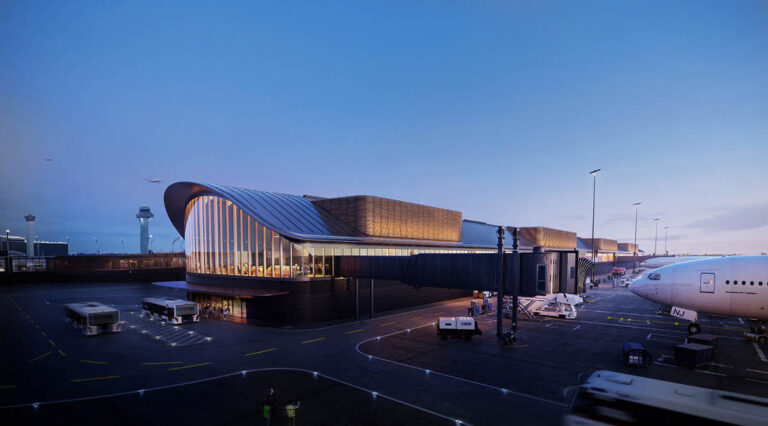
Key takeaways
- Chicago O'Hare's $12.5 billion ORDNext program will add 35 gates and redesigned connections, but construction delays pushed the centerpiece Global Terminal from 2028 to 2034.
- American and United are already increasing seat capacity from O'Hare despite an FAA flight cap through October 2027, expanding award seat availability even with a frozen flight count.
- The new Global Terminal enables international-to-domestic connections without leaving the secured area, potentially supporting the TSA's One Stop Security pilot program.
Travelers passing through Chicago O’Hare International Airport in recent months cannot help but notice the construction. Cranes dominate the skyline, barriers redirect foot traffic, and announcements remind passengers that work is underway on one of the most ambitious infrastructure projects the airport has attempted. The reason: ORDNext, a $12.5 billion redevelopment program that will fundamentally reshape how passengers move through and connect at one of the world’s largest aviation hubs.
Understanding the ORDNext Scope
The scale of ORDNext is difficult to overstate. The project calls for building a new Global Terminal and associated concourse on the site of the existing Terminal 2. Simultaneously, two new linear satellite concourses are rising southwest of United Airlines’ Terminal 1. These facilities will be connected by a new underground train system and pedestrian walkways, creating a seamless network across the airport’s terminal area.
The financial commitment reflects the ambition: when ORDNext launches fully, it will increase O’Hare’s gate count from 185 gates in 2018 to approximately 220 gates. For context, this represents a 19% increase in physical capacity, transforming the footprint of the entire operation. The project also reflects a strategic priority for the city of Chicago and the airlines operating there. American Airlines and United Airlines both maintain major hub operations at O’Hare, and both carriers view the expanded capacity as essential to their growth ambitions in coming years.
The Construction Timeline and What Opens When
ORDNext is not a single event but a series of openings spread across more than a decade. Understanding the timeline matters for travelers, particularly those planning award travel and seeking to understand when new routes and connections might become available.
Concourse D: The First Major Milestone
Concourse D is scheduled to open by the end of 2028. According to an August 21 bond prospectus from the Chicago Department of Aviation, the concourse will be connected aboveground to Concourse C. It will feature 19 gates with the flexibility to handle either a single twin-aisle aircraft (such as a Boeing 787 or Airbus A350) or two single-aisle aircraft (like 737s or A320s) at each gate. However, an important caveat exists: while Concourse D will serve both domestic and international flights, international arrivals cannot begin operations until the Global Terminal opens. This sequencing reflects the infrastructure requirements for customs and immigration processing.
The Global Terminal and Its Delays
The Global Terminal represents the architectural and functional centerpiece of ORDNext. However, it also represents where the project faces its most significant delays. Construction is not scheduled to begin until 2029, and the facility will not open until 2034. This represents a six-year delay from the original plan, which called for a 2028 opening.
The delays accumulate from multiple pressures. The original project, approved in 2018, carried a budget of $8.5 billion and an optimistic timeline. The COVID-19 pandemic disrupted construction schedules nationwide. Construction costs have escalated substantially, necessitating a revised budget of $12.5 billion. The Chicago Department of Aviation’s prospectus documents these delays, confirming that travelers will wait considerably longer than originally anticipated before experiencing the full benefits of the modernization.
Concourse E: Two Phases Across the Decade
Concourse E, located west of Concourses C and D, is designed to serve regional aircraft and domestic single-aisle planes. It will open in two distinct phases: a 14-gate northern segment in 2030 and a 10-gate southern segment around 2034. This phased approach allows the airport to absorb and operationalize capacity in manageable increments rather than overwhelming the system with a single massive opening.
What’s Already Done
The project is not entirely future-focused. A 10-gate expansion of Terminal 5 opened in 2023, adding capacity that has already benefited passengers. More recently, Concourse L received a three-gate expansion, further incrementally increasing the airport’s throughput. These completed elements demonstrate that while delays characterize the project’s overall arc, work continues and portions of ORDNext are already operational.
Capacity Growth and Airline Strategy
Understanding why airlines are pursuing aggressive expansion at O’Hare requires understanding a regulatory constraint: the Federal Aviation Administration has capped flight operations at the airport through at least October 2027 to manage congestion. This cap creates a paradoxical situation—airlines want to grow, but the number of available departure slots is frozen.
The answer lies in aircraft deployment. If the number of flights cannot increase, airlines can still expand seat capacity by flying larger aircraft on existing routes and by adjusting their deployment strategies to emphasize high-capacity equipment. Schedule data from aviation analytics firm Cirium illustrates this strategy in action.
American Airlines, for example, is scheduled to operate nearly 21% more seats from O’Hare in 2026 compared to 2025. This expansion in seat capacity translates to an 18% increase in total departures from the airline’s O’Hare base. United Airlines is pursuing a similar strategy, with over 13% more seats planned and a 14% increase in departures. These metrics reveal a critical dynamic for frequent flyers and award travelers: even within a constrained flight schedule, seat supply is growing. This growth directly affects award availability, as more seats per flight means more opportunities for award bookings, even if the total number of departures remains static.
Transforming the Passenger Experience
ORDNext is more than gates and concourses. It reflects a strategic vision about how passengers should move through the airport and experience transfers and connections.
Eliminating the Terminal 5 Schlep
Currently, passengers connecting from an international arrival to a domestic flight at O’Hare face an inconvenient process. They land at Terminal 5, exit the secured area, clear customs and immigration, collect their baggage (or retrieve it from the carousel if connecting), and then must travel to the main terminal core to check in for their domestic flight and re-clear security. This journey is time-consuming and adds friction to the connection.
The Global Terminal changes this equation. It will be designed to enable international-to-domestic connections without passengers leaving the secured area. This architectural feature alone significantly improves the customer experience for award travelers piecing together complex multi-leg itineraries that include international and domestic segments.
One Stop Security and Its Potential
The benefits could extend further. If the Transportation Security Administration and U.S. Customs and Border Protection expand their One Stop Security pilot program to O’Hare, connecting passengers could bypass the secondary security screening entirely. The pilot program, currently operating at select airports, aims to streamline the connection process by consolidating security and customs functions. Expanding it to O’Hare would represent a substantial quality-of-life improvement for connecting passengers.
Designing for Chicago
The Global Terminal’s architecture, designed by a consortium led by Chicago-based Studio Gang, reflects an intentional philosophy: the moment a passenger steps off a plane into the terminal should feel authentically Chicago. Juliane Wolf, a design principal at Studio Gang, articulated this vision in 2020, stating the ambition that passengers should sense they have arrived in Chicago upon entering the terminal. This stands in contrast to the generic, interchangeable quality of O’Hare’s existing terminal configuration. The new facility aims to create a sense of place and destination, not merely a functional conduit.
What Comes Next for Award Travelers
For those tracking award availability and flight patterns, ORDNext introduces both immediate and long-term dynamics. In the near term, through October 2027, the FAA flight cap constrains the total departure count, meaning award seat availability will depend heavily on aircraft selection and which routes receive the highest-capacity equipment.
Long-term, once the new concourses and Global Terminal come online, O’Hare will accommodate substantially more flights and passengers. The expanded gate count and improved infrastructure will reinforce Chicago’s position as a major hub for international travel, benefiting passengers seeking connections to Europe, Asia, and other long-haul destinations. For award travelers, a stronger, more modern O’Hare means more options and a more competitive hub environment where both carriers continually improve their offerings to attract revenue and award passengers.
Frequently Asked Questions
When does each part of ORDNext open?
Concourse D opens by the end of 2028, Concourse E's first 14-gate phase in 2030, and the Global Terminal plus Concourse E's second 10-gate phase both in 2034.
Why is O'Hare expanding if the FAA capped flights?
The FAA flight cap through October 2027 limits total departures, but American Airlines and United Airlines are meeting growth demands by flying larger aircraft—American plans 21% more seats and United 13% more seats—increasing award availability without adding more flights.
What caused the six-year delay to the Global Terminal?
The original 2018 plan budgeted $8.5 billion with a 2028 opening, but the COVID-19 pandemic disrupted schedules and construction costs escalated, requiring a revised $12.5 billion budget and pushing completion to 2034.
