
Key takeaways
- Delta’s Basic Business fares are available for purchase immediately but won’t begin flying until September 2026 in select markets.
- This development reflects Delta’s larger strategy of unbundling premium cabin experiences and selling amenities separately rather than as package deals.
- The lounge access restrictions hit premium credit card holders particularly hard.
- Delta’s approach to lounge access restrictions represents a decade-long pattern of incremental changes that have steadily reduced the amenities tied to premium fares.
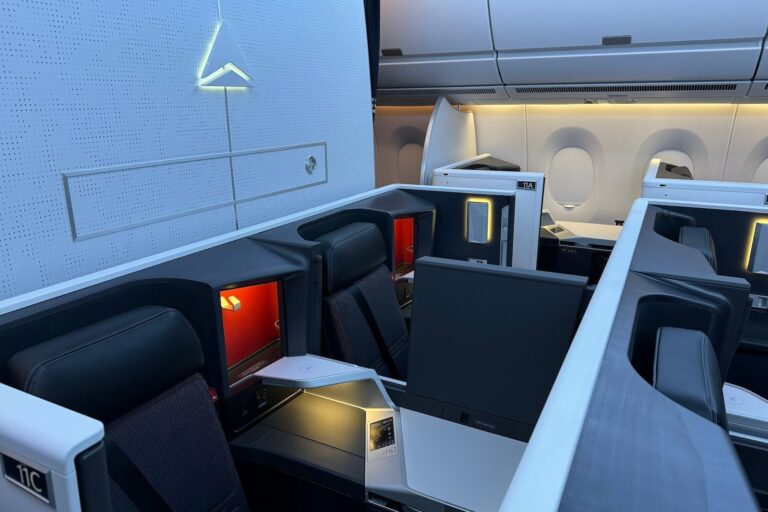
Delta Air Lines officially launched “Basic Business” fares for its Delta One long-haul cabin on July 8, 2026, marking a significant shift in how the carrier bundles premium cabin amenities with ticket prices. These new basic-tier premium fares exclude lounge access, seat selection, and free changes—benefits traditionally guaranteed to business-class passengers. The move represents Delta’s aggressive expansion of a tiered fare structure that now extends across every cabin class, fundamentally reshaping what premium air travel includes at each price point.
The New Premium Fare Hierarchy Takes Shape
Delta’s Basic Business fares are available for purchase immediately but won’t begin flying until September 2026 in select markets. Alongside Basic Business, Delta simultaneously introduced Delta First Basic for domestic and Latin American routes, plus Delta Premium Select Basic and Business options across its international network. Each of these new “Basic” tiers comes with specific trade-offs: reduced baggage allowances, lower mileage earnings, and elimination of upgrade eligibility—changes that fundamentally alter the value proposition of premium cabin bookings.
The lounge access restrictions form the centerpiece of these changes. Starting January 19, 2027, customers traveling in Basic Business will have no access to the Delta One Lounge, the carrier’s most exclusive premium lounge. However, Delta is implementing a grace period: travelers on Basic Business fares through January 18, 2027, retain access to both Delta One check-in facilities and the Delta One Lounge itself. This transitional window gives frequent flyers time to adjust their booking strategies before the full restrictions take effect.
A Broader Unbundling Strategy Accelerates
This development reflects Delta’s larger strategy of unbundling premium cabin experiences and selling amenities separately rather than as package deals. By creating “Basic” versions of premium fares, Delta captures price-sensitive business travelers willing to sacrifice lounge access and other perks for lower ticket costs. The strategy mirrors what low-cost carriers pioneered decades ago but applies it to premium cabins where customers historically expected comprehensive amenity packages.
The timing of these changes aligns with Delta’s broader lounge access restrictions implemented earlier in 2025. As of February 1, 2025, Delta Sky Club access became limited to a three-hour window before departure for all eligible members—a significant tightening from previous policies that allowed earlier entry. This rule applies universally except for connecting passengers, meaning even elite frequent flyers and credit cardholders face stricter access windows. Simultaneously, American Express Platinum cardholders and Delta SkyMiles Reserve members saw their unlimited lounge benefits capped at 10 and 15 annual visits respectively, unless they spend $75,000 annually to regain unlimited access.
Credit Card Holders Face Reduced Value Propositions
The lounge access restrictions hit premium credit card holders particularly hard. Delta SkyMiles Reserve cardholders and American Express Platinum cardholders previously enjoyed unlimited Delta Sky Club access as a core benefit, but that unlimited access now requires meeting substantial annual spending thresholds. This change dramatically reduces the perceived value of premium credit cards for business travelers who relied on consistent lounge access across their frequent travel.
Adding Basic Business fares to this equation further complicates the value equation. A traveler holding a Delta credit card who books a Basic Business fare will find themselves locked out of the Delta One Lounge entirely—even if they hold elite Medallion status or a premium credit card. Lounge access under the new system requires one of three conditions: a non-Basic premium fare, a standalone Delta Sky Club membership, or an eligible credit card that hasn’t exhausted its annual visit limit.
A Decade of Incremental Restrictions
Delta’s approach to lounge access restrictions represents a decade-long pattern of incremental changes that have steadily reduced the amenities tied to premium fares. What began as perks bundled universally with premium tickets has evolved into a tiered system where even business-class passengers must verify their specific fare type and membership status before claiming lounge entry. The renaming of Basic Economy to “Delta Main Basic” effective October 1, 2025, formalized this new terminology while maintaining the same restrictions: no Sky Club access, no mileage accrual, and no upgrade eligibility.
The carrier’s unbundling approach gained momentum as other major U.S. airlines implemented similar strategies, creating industry-wide pressure to reduce the all-inclusive nature of premium cabin pricing. Delta’s execution across multiple fare tiers simultaneously—Basic Business, Delta First Basic, Premium Select Basic, and Main Basic—demonstrates the systematic nature of this transformation.
What Travelers Must Monitor Moving Forward
The critical date for business travelers is January 19, 2027, when Basic Business lounge access restrictions take full effect. Frequent flyers booking Delta One tickets between now and January 18, 2027, can still access the Delta One Lounge if they purchase Basic Business fares, but that window closes definitively in mid-January. Travelers should review their September 2026 through January 2027 bookings carefully to understand which fare type they purchased and whether lounge access is included.
Delta’s fare restructuring reflects a broader industry shift toward granular pricing where amenities once bundled together are now sold separately. For business travelers, this means scrutinizing every premium ticket purchase to confirm exactly which amenities are included—lounge access cannot be assumed even for Delta One passengers. The changes force a recalculation of premium travel value that will reshape how corporate travel managers evaluate Delta bookings against competitors.
