
Key takeaways
- United cardholders redeem at 90,000 miles one-way on Singapore-San Francisco routes (4.5 cents per mile value), while non-card holders pay 250,000 miles for the same award.
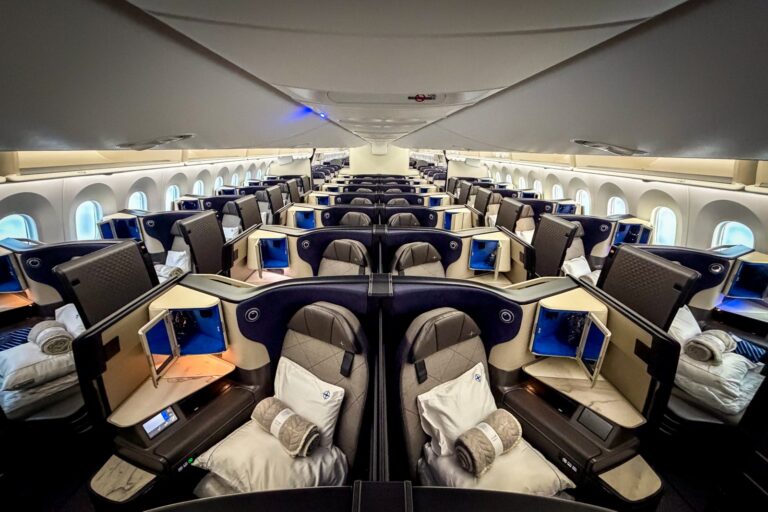
- The new Elevated Polaris cabin features sliding privacy doors (pending certification), 78-inch lie-flat seats, and a sophisticated graphite-and-navy color scheme distinct from older Polaris cabins.
- The airline's upgraded wine program includes a cabernet sauvignon retailing for over $100 per bottle, and a light Tapas menu available up to two hours before arrival outperforms standard entrée options.
- Each 787-9 carries 64 Polaris seats including eight premium Studios in bulkhead rows, with availability appearing consistent on long-haul routes as more new aircraft enter service.
United’s newly delivered Elevated Polaris business class represents a meaningful shift in the carrier’s long-haul premium offering. The suite-style pods began service this spring, rolling out across the airline’s newest Boeing 787-9 Dreamliners. We had the opportunity to fly this product one-way from Singapore Changi to San Francisco, experiencing the standard configuration after flying nearly 16 hours in seats that signaled a design philosophy centered on privacy and refinement.
Award Pricing and Access
The redemption math on this route favors United credit card holders significantly. Our one-way award ticket from Singapore to San Francisco required 90,000 MileagePlus miles plus $74.23 in taxes and fees, pricing out to approximately 4.5 cents per mile against the $4,148 cash fare. That redemption rate surpasses The Points Guy’s published valuation of United miles and represented the lowest award level available on this route for the entire following year.
Credit card status unlocks this preferred redemption tier. Without a United cobranded card or Premier elite status, the same flight would demand 250,000 miles—a difference of 160,000 miles that underscores the value of qualifying for the card holder rate. Premium cabin upgrades on this aircraft also reflect changing pricing. Studio seats in the bulkhead rows carried a $599 advance purchase fee, though that dropped to $499 at check-in, a reduction that apparently moved several seats from available to booked by departure time.
The cabin configuration
Each 787-9 carries 64 total Polaris business-class seats, with eight premium Studios occupying the two bulkhead rows. The remaining 56 standard seats occupy two large cabins split into eight rows of four across the aircraft. Side-facing angles position window-seat passengers toward the exterior rather than across the aisle at other travelers. Center seats in the forward cabin angle toward each other with greater seatback separation, while center seats in the aft cabin position footrests toward the aisle, a configuration that may favor couples traveling together.
Privacy and design evolution
The defining feature of this cabin redesign is the introduction of sliding doors at each suite. Unfortunately, the specific aircraft we boarded had not yet received regulatory certification for door closure, so the crew kept them locked open. Once certified, passengers will gain the ability to fully enclose their space—a privacy upgrade that distinguishes these suites from previous business-class iterations. The aesthetic overhaul moves away from sky-blue and brushed chrome toward a more restrained palette of textured graphite-gray shells, navy-blue interior walls, silvery-gray seating upholstery with accent stitching, and caramel-toned wood paneling. The footprint measures 54 inches tall for the door frame with a 9-inch gap between the armrest and the preceding seat shell.
Seat Mechanics and Personal Controls
The seat itself operates through both preset buttons and an adjacent touchscreen interface that controls individual seat components via a scrolling scale. Recline extends to a full 78-inch lie-flat position, sufficient for average travelers but potentially tight for those above 6 feet 2 inches. The foot cubby measures 12 inches tall and 16 inches wide, offering space to shift positions without striking the walls.
Storage compartments include a small locker beside the seatback with a mirror for noise-canceling headsets and amenity kits, plus an armrest-mounted water bottle holder that raises or lowers up to 11 inches. The glossy faux-marble shelf beside the seat houses a wireless charging pad—our iPhone 17 Pro gained approximately 1 percent charge every five minutes—along with a corded entertainment remote, a universal power outlet, and two USB-C ports.
The seat’s touchscreen pad also controls cabin lighting and allows passengers to adjust the ambient color palette, a feature that consumed considerably more attention than its functional value warranted. A 19-inch OLED 4K entertainment display emerges above, with a massive tray table deploying below the screen to a 24-by-16-inch unfolded surface—ample room for both meal service and a laptop simultaneously.
Amenities and Creature Comforts
Bedding remains United’s familiar Saks Fifth Avenue package: a cooling gel pillow with lumbar support, a medium-size soft pillow, a lightweight blanket, and a heavy duvet wrapped in plastic. Soft slippers appeared on the seat ottoman, and we wore them for the majority of the flight. The Brooks Brothers amenity kit proved compact and stowable, stocked with skincare items from Perricone MD.
Four lavatories serve the business cabin—one per 16 passengers, positioned behind the flight deck near the front galley and alongside the second galley. They remained reasonably available except for the post-meal rush and were stocked with Perricone MD and Therabody products. Overhead air nozzles allowed individual temperature control, a refinement that proved valuable when the wider cabin ran warm.
Connectivity and entertainment
United is rolling out Starlink Wi-Fi complimentary to MileagePlus members on equipped aircraft, though this particular Dreamliner lacked the hardware. The airline’s free messaging plan for MileagePlus cardholders functioned adequately for text and WhatsApp but not email or other applications. We upgraded to the full-flight paid Wi-Fi plan for $8, which delivered sufficient bandwidth for email and light browsing across both laptop and phone.
The 19-inch HD entertainment system navigated easily and supported Bluetooth connectivity with personal earbuds when the seat’s headphone jack malfunctioned—apparently a documented issue worth noting. The film selection included recent theatrical releases such as “The Devil Wears Prada 2,” “The Super Mario Galaxy Movie,” and “Project Hail Mary,” while television programming drew from HBO’s catalog, including “House of the Dragon” and “Rooster.”
Food Service and Beverage Program
United’s recent wine upgrade became immediately apparent. Boarding service offered Gambino prosecco retailing for approximately $10 per bottle. The beverage selection throughout the flight included sodas, juices, Illy coffee, Twinings teas, and beers spanning Michelob Ultra, Stella Artois, and Bell’s Two Hearted IPA. The standout selection was a cabernet sauvignon retailing for well over $100 per bottle, a choice that tasted notably refined at altitude.
Passengers may preorder main courses up to 24 hours in advance, with a preorder-exclusive salmon entrée available. Service began roughly 20 minutes after takeoff with beverages and warmed nuts, followed by a first course presenting multiple options, and an entrée service beginning about one hour into the flight. The beef entrée arrived competently prepared, though the accompanying potato lacked distinction and the ratatouille—primarily chopped bell peppers in semi-sweet sauce—required adjustment.
Specialty menu tiers
A light “Tapas” selection available up to two hours before arrival offered a superior dining experience. This option permitted selection of up to four small dishes to customize, combining fresh, flavorful preparations that provided an authentic taste of Singapore. A prearrival meal preceded final descent, with choices including poached shrimp in congee with fresh ginger and scallions for flavor, accompanied by fresh fruit and a croissant. Between formal services, the galley stocked oranges, bananas, potato chips, and instant noodle soup for on-demand ordering.
The meal services demonstrated efficiency and precise execution. We would recommend prioritizing the Tapas course over the standard entrées on repeat flights, given its superior flavor profile and portion-to-interest ratio.
Ground and Cabin Operations
Singapore Changi Terminal 2 provided dedicated check-in lines for business-class passengers, with immigration processed quickly. A 15-minute walk led to the gate, which opened for security screening just before the standard 55-minute boarding window began. First-class passengers boarded first, followed by the business cabin. We accessed Singapore Airlines’ business-class KrisFlyer Lounge, which offered multiple seating zones and an extensive buffet with live cooking stations, though the midday rush limited meaningful lounge time.
Once airborne, the cabin remained thoughtfully quiet. Most passengers kept electronic window shades in the darkest position throughout the flight, a courtesy that preserved rest conditions for all. Cabin crew maintained lavatory cleanliness diligently, and overhead air management provided individual comfort control regardless of cabin-wide temperature settings.
The Verdict
United’s Elevated Polaris cabin represents a genuine product refinement for long-haul business travel, distinguishing itself through deliberate design choices centered on privacy, sophisticated aesthetics, and elevated dining. The sliding doors remain the most compelling differentiator, pending final certification. Award availability appears robust on this route for card holders willing to commit 90,000 miles, and the redemption value justifies the spend against comparable paid fares. Future flights will determine whether the roomier Studio configuration and fully functional doors enhance the experience further. Until then, this cabin delivers the specific combination of refinement and utility that modern business travelers increasingly seek.
Frequently Asked Questions
How much do United Elevated Polaris awards cost in miles?
United cardholders redeem one-way awards on this route for 90,000 MileagePlus miles plus $74.23 in taxes and fees. Without a United card or Premier status, the same flight costs 250,000 miles.
What is the lie-flat length of the standard Elevated Polaris seat?
The seat reclines to a full 78-inch lie-flat position with a foot cubby measuring 12 inches tall and 16 inches wide.
When will the privacy doors on the new Polaris suites be available?
The privacy doors are designed into the new suites but require regulatory certification before passengers can close them. The reviewed aircraft had doors locked in the open position pending certification completion.
