
Key takeaways
- Qantas A380 business class to Australia costs $4,600–$5,800 cash or 80,000–151,800 award points depending on the program.
- Alaska Airlines Atmos Rewards offers the best award value at 80,000 points one-way LAX-Melbourne, with points transferable via Bilt credit card at a 1:1 ratio.
- Award seats release monthly in limited batches; monitoring tools like Seats.aero are essential for booking before inventory disappears.
- The A380's upper deck lounge, kangaroo pajamas, and Neil Perry-designed dining are standout amenities, but Wi-Fi arrives mid-2027 and the aircraft exits the route October 2026.
My first Qantas A380 flight came in 2009, shortly after the airline began receiving these double-deck aircraft. Since then, I’ve watched these jumbo jets transform from cutting-edge novelties into essential long-haul workhorses for carriers including Qantas, Emirates, and Singapore Airlines. The A380 survived the COVID-19 pandemic despite predictions it would become obsolete, and Qantas continues to operate 10 of them today. I’ve flown the aircraft dozens of times between the U.S. and Australia across multiple years. On a recent Los Angeles-to-Melbourne routing at the start of my honeymoon, I experienced Qantas business class for the first time in several years, flying in the A380 with tail number VH-OQK, named after aviation pioneers John and Reginald Duigan.
Award Redemption Costs and Cash Fares
A one-way Qantas business-class ticket from Los Angeles International Airport to Melbourne Airport during my travel week would have cost between $4,600 and $5,800 in cash. The airline offers award redemptions through multiple programs, each with different point requirements.
Comparing Frequent Flyer Programs
Alaska Airlines Atmos Rewards proved the most efficient option at 80,000 points for the same routing. American Airlines AAdvantage required 90,000 miles, while redeeming directly through Qantas Frequent Flyer would have cost 151,800 points. However, Capital One was running a 20 percent transfer bonus to Qantas at the time I booked, which would have reduced that requirement to just 121,440 miles, though I had already accumulated more Alaska points and preferred not to risk a transfer delay that could cost me the award seat.
The speed of movement matters because Qantas releases business-class awards extremely sparingly to partner programs. The airline typically opens only a handful of seats each month, released in tranches across multiple dates in the following weeks. Missing a release window means waiting for the next batch.
How to Earn Points Quickly
Alaska Airlines is a direct 1:1 transfer partner of the Bilt credit card, making it an efficient way to accumulate points. Alternatively, Marriott Bonvoy points transfer to Alaska at a 3:1 ratio. American Airlines AAdvantage can be earned through cobranded credit cards that offer sign-up bonuses, though building a balance through spending alone requires significant volume.
The Challenge of Award Availability
Finding and booking these tickets before they disappear is the real hurdle. I use monitoring tools like Seats.aero to track award inventory across multiple months and receive alerts the moment seats become available on my target dates. Without such tools, trying to manually search multiple times per day across different programs would be impractical. Even with these alerts, awards can disappear within hours of becoming available, particularly around peak seasons and holiday periods.
A380 Upper Deck Business Class Configuration
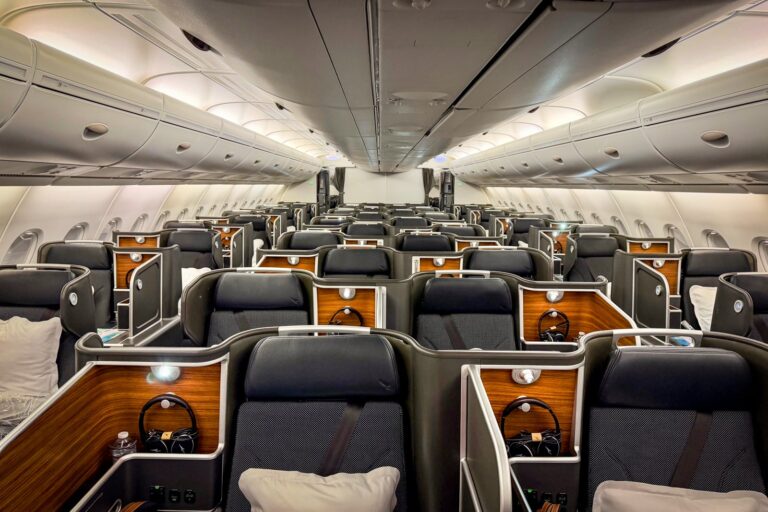
The A380’s business class occupies nearly the entire upper deck. Qantas configured it with 20 seats in the forward cabin and 50 seats in the larger rear cabin behind the galley and lavatory, all arranged in a staggered 1-2-1 pattern that ensures every passenger direct aisle access.
Seat Layout and Physical Dimensions
The single seats along each side benefit from direct window access, though their proximity to the window alternates based on the placement of a wide armrest. The middle pairs have a raisable privacy shield between them and wider armrests separating each set of seats, creating more isolation than the single seats. However, unlike some newer first-class suites on aircraft like the forthcoming A350, these seats lack sliding doors for complete cabin closure.
The actual seat width measures 18 inches at the shoulders, while the gap between armrests at hip level extends to 24 inches, providing a genuinely roomy feel. The exit gap from the seat is 10 inches, which exceeds what you find in competing forward-facing business-class products. In lie-flat mode, the seat stretches to 80 inches, and I found it comfortable for sleeping across various positions throughout the 15-hour flight. The footwell is 14 inches wide and 11 inches tall, accommodating most feet but potentially feeling snug for passengers in larger shoe sizes.
Storage space is limited in the middle pairs; the single side seats have large window-mounted bins for amenity kits and bedding that the middle seats don’t access as easily. The seat’s tray table measures approximately 11 by 19 inches, providing plenty of room for a laptop. Two overhead air nozzles let passengers independently manage cabin temperature in their area.
Onboard Amenities and Special Touches
Qantas equipped each seat with a 15.5-inch entertainment screen that tilts up and down for viewing flexibility in both upright and reclined positions. The seat controls include preset positions for takeoff, landing, lounging, and full lie-flat mode, along with buttons for adjusting individual components and ambient lighting. The screen offered dozens of new movies and TV shows, including The Devil Wears Prada 2, Hoppers, and The Super Mario Galaxy Movie. However, connecting personal headphones via Bluetooth was not possible; only the provided wired headphones worked with the system.
The bedding provided includes a lightweight duvet, a seat cover (a particularly thoughtful inclusion), and a medium pillow. Flight attendants distributed pajamas shortly after boarding, and I requested a large-extra large fit despite the medium option fitting adequately, as I prefer roomy sleepwear. The amenity kit came from R.M. Williams, an Australian clothing and leather brand, adding authentic regional character.
The Upper Deck Lounge
One of the A380’s distinctive features is a dedicated lounge located at the front of the upper deck, exclusive to premium business- and first-class passengers. It features a long banquette with seat belts for relaxing with travel companions, plus two tables equipped with power outlets and seat belts on either side of the staircase leading down to the lower deck. This space provides an informal gathering area that competitors simply cannot match given the aircraft’s configuration. The lounge exists because the aircraft’s double-deck design creates space that narrowbody and single-deck widebody cabins cannot offer.
Dining and Beverage Service
The menu was designed by Neil Perry, Qantas’s chef partner. Service began about an hour into the flight with Jacquart Mosaique Brut Champagne and mixed nuts served in Noritake porcelain bowls. Given the late-evening departure and passengers’ desire to rest, the airline served the main course in one consolidated tray rather than multiple courses, though flight attendants remained efficient despite the cabin’s 70-seat size. Meal service lasted approximately 90 minutes.
Options included a green salad and a choice of chicken curry, beef, or vegetarian preparations. I selected the curry, which arrived with a hearty portion, light but flavorful sauce, and notably tender meat. The dessert course offered cheeses including Manchego and Fourme d’Ambert, tiramisu, ice cream, or seasonal fruit; I chose the latter for a lighter finish. Throughout the remainder of the flight, the crew could serve additional dishes on demand:
- Crudités with hummus
- Chicken-cheese sandwich with roasted peppers and zucchini
- Cookies and chocolate bars
- Mixed nuts, potato chips, and fruit
The wine list, though not printed on the menu, included a chardonnay from Victoria, a sauvignon blanc-semillon blend from Western Australia, a Shiraz from the Barossa Valley, and a pinot noir. Additional spirits featured Four Pillars gin and Bundaberg dark rum, alongside Australian beer selections. Flight attendants regularly circulated with refill offers throughout meal service.
About 90 minutes before landing in Melbourne, the cabin lighting gradually increased and breakfast service began for passengers who wished to eat. Those still sleeping received their trays after waking. This staggered approach worked because passengers completed menu cards earlier, allowing crew to pre-assemble most elements. Breakfast options included juices, coffee, tea, yogurt, fruit salad, muesli, toast, croissants, and hot entries such as scrambled eggs, along with other prepared dishes. The coffee arrived hot and strong, the eggs came out well-prepared, and portions were substantial.
The Connected Flight Experience and Timeline
The primary drawback to this route remains the absence of Wi-Fi connectivity aboard Qantas A380s. For business travelers who must stay online during long-haul flights, this is a meaningful limitation. Qantas has begun installing Wi-Fi systems and expects to complete the rollout across all 10 A380s by mid-2027.
The aircraft deployment on the Los Angeles-Melbourne route is also shifting. Qantas currently operates both A380s and 787-9 Dreamliners on this service, but will transition exclusively to 787-9s beginning in October 2026. That timeline means existing A380 bookings have limited opportunity windows before the aircraft exit this route entirely.
For business-class travel across the Pacific, Qantas remains a compelling option despite the A380’s age. The crew professionalism, cabin design, onboard lounge, and dining quality deliver a polished long-haul experience. The kangaroo pajamas and R.M. Williams amenity kit add Australian character that purely functional service does not. Award availability remains the real challenge—Qantas releases so few business-class seats to partner programs that catching them requires vigilance and monitoring tools. The value proposition shifts dramatically depending on which program you redeem through, with Alaska’s 80,000-point award substantially outperforming the Qantas direct rate. Once Wi-Fi arrives and the aircraft transition completes, the passenger experience will evolve further.
Frequently Asked Questions
How many Qantas A380s are currently in service?
Qantas operates 10 A380s today. The airline will transition to Boeing 787-9 Dreamliners exclusively on the Los Angeles-Melbourne route starting in October 2026.
Which frequent flyer program offers the best redemption value for Qantas business class LAX-Melbourne?
Alaska Airlines Atmos Rewards requires only 80,000 points, compared to 90,000 American AAdvantage miles or 151,800 Qantas Frequent Flyer points. Alaska is a 1:1 transfer partner of Bilt credit card, and Marriott Bonvoy transfers at a 3:1 ratio.
When will Qantas A380s have Wi-Fi, and why does it matter?
The airline expects to complete Wi-Fi rollout across all 10 A380s by mid-2027. Currently, the lack of connectivity is the primary drawback for business travelers who need to stay online during the 15-hour flight.
