

Key takeaways
- Gondola's MCP integration lets ChatGPT access your loyalty accounts, travel preferences and past trips to deliver personalized travel recommendations.
- The tool learns your preferences over time as you provide more information, improving recommendations but requiring you to share more travel data.
- Setup takes minutes via OAuth, though company workspace administrators may restrict plugin installation on work accounts.
- Recommendations are personalized but imperfect, so treat the tool as one planning resource among others rather than your sole authority.
Gondola AI, the data provider behind many monthly hotel points valuations in this publication, recently rolled out a new integration that connects your loyalty and travel data directly to ChatGPT and other AI clients. The integration uses MCP—Model Context Protocol—an open standard that lets AI applications pull information from external tools and databases.
The appeal is straightforward: if ChatGPT knows your home airport, your preferred hotel chains, your loyalty status and your upcoming itinerary, it can offer travel advice tailored to your actual circumstances rather than generic guidance. I tested the integration after provisioning Gondola access to my travel-related email accounts and connecting it to my personal ChatGPT account to see whether this tool warrants regular use alongside other planning resources.
How Gondola’s MCP Integration Works
Model Context Protocol is an open standard designed so that AI applications can connect to external data sources and tools. Think of it as a translator between your AI chat client and the services that hold your travel information. Gondola’s implementation lets ChatGPT, Claude Desktop and other supported AI clients fetch your travel data on demand within a conversation.
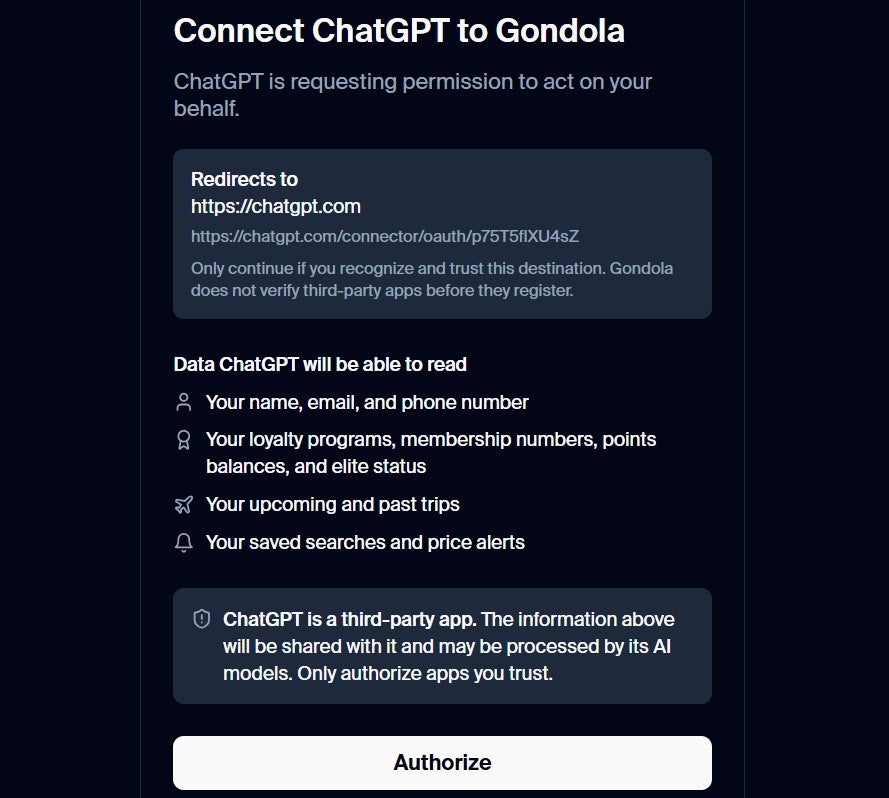
The data Gondola can share with your AI client depends on what you’ve already connected to your Gondola account. This might include your travel preferences—home airport, preferred hotel brands, favored airlines—your loyalty account details such as status levels and points balances, details of your upcoming trips, and records of where you’ve traveled before. When you ask ChatGPT a travel planning question, it can now consult that Gondola data to inform its response.
Installation and Authorization
Getting Gondola connected to ChatGPT is straightforward. Gondola provides a link on its website that installs the ChatGPT plugin directly. You’ll see a permissions screen before clicking Authorize, which is worth reviewing since it grants ChatGPT access to request information from your Gondola account. Gondola uses OAuth for this connection, meaning you can revoke access at any time from the Connected Agents page in your Gondola account.
One caveat: if you access ChatGPT through a company workspace, your administrator may restrict which plugins you can install. I encountered this limitation when trying to set up the integration on a work-provided ChatGPT account, though I had no trouble with my personal account.
What You Can Ask It to Do
Gondola’s MCP integration is designed with several use cases in mind. Travelers can ask it to help select a hotel by providing recommendations based on their known preferences and loyalty status. You can request flight recommendations taking your preferred airlines and home airport into account. The tool can help you understand which of your loyalty accounts might be best suited for a specific redemption or travel goal. You can also get suggestions for how to approach award travel planning given your points balances and status levels.
Gondola provides sample prompts to help you get started, like asking it to find a hotel in a city you’re visiting that matches your travel style, or requesting flight options for an upcoming trip that would maximize the value of a specific loyalty account. The tagline suggestion is to include @Gondola in your prompt for best results.
Personalization Through Learning
Gondola describes its travel profile as something that evolves as it learns your preferences over time. I used the MCP integration for a week while actively planning travel and explicitly telling ChatGPT about my hotel preferences through repeated prompts. As I provided more information about what I typically look for, the tool’s responses became more aligned with my actual travel style.
For example, when I asked a particular planning question again a week into testing, ChatGPT offered a response better suited to my preferences than its initial answer had been. The depth and relevance of the tool’s recommendations directly correlates with how much information you’ve shared with Gondola. Travelers who’ve connected their travel-related email accounts or provided extensive travel history and preference details will see more personalized results than those who haven’t.
This creates a deliberate tradeoff: richer recommendations require sharing more of your travel information with the service. As you feed it more data about your trips, preferences and loyalty activity, its usefulness increases—but so does the amount of personal travel information residing with Gondola and accessible through your AI client.
What I Found When Testing
The specificity of Gondola’s responses surprised me during testing. When I posed prompts similar to Gondola’s suggested examples, ChatGPT incorporated details from my travel plans and stated preferences to build genuinely personalized advice. The responses weren’t generic hotel-booking guidance or airline-selection frameworks; they reflected my specific upcoming itinerary and loyalty positions.
Initial Results
My first round of testing showed that Gondola had successfully shared enough context about my travel patterns for ChatGPT to offer relevant suggestions. The recommendations took into account not just which cities I was visiting but which hotel brands I preferred and what status I held in various loyalty programs.
Improvement Over Time
The real shift came when I returned to the same prompts after a week of providing additional context. By explicitly discussing my hotel preferences while planning actual trips within the MCP-enabled ChatGPT conversation, I saw more targeted results. ChatGPT wasn’t just pulling data from my Gondola profile; it was also absorbing preferences I stated directly in our chat and incorporating those into future responses.
Notable Gaps
That said, both my initial and later responses included errors or misses. Sometimes Gondola suggested hotels that, while matching some stated preferences, didn’t align with what I’d actually choose. On occasion, ChatGPT seemed to misinterpret which loyalty account would be best for a particular scenario. The personalization remains imperfect—having access to your data doesn’t guarantee every recommendation will be accurate.
The Privacy and Accuracy Tradeoff
The integration presents a clear bargain: accept sharing more travel information with Gondola in exchange for more intelligent travel planning assistance from your AI client. Depending on your comfort level with data sharing, that may be an acceptable arrangement or not.
The accuracy question matters too. Personalization is only valuable if the recommendations are sound. My testing showed that Gondola and ChatGPT get many things right, particularly about which loyalty programs make sense for your circumstances. But not every suggestion is worth acting on, which means you still need to think critically about advice before booking.
Is It Worth Using?
If you’re already using ChatGPT to research and plan travel, Gondola’s MCP integration is worth trying. The setup takes minutes, and you can revoke access whenever you like. The personalization genuinely does improve ChatGPT’s travel advice, especially once you’ve spent time telling the tool about your preferences and trip details.
The tool works best as one input among many. I plan to keep using it alongside other resources when researching trips and evaluating redemptions, rather than treating it as my sole planning authority. For travelers who value AI assistance in trip planning and aren’t concerned about sharing travel information with Gondola, this integration transforms ChatGPT into a moderately useful travel-specific assistant.
Frequently Asked Questions
What is MCP and how does Gondola use it?
MCP (Model Context Protocol) is an open standard allowing AI applications to connect to external tools and data. Gondola uses MCP to let ChatGPT, Claude Desktop and other supported AI clients access your travel preferences, loyalty account details and trip history to personalize travel recommendations.
How does the Gondola MCP integration improve its recommendations over time?
Gondola's travel profile learns from information you share. As you provide more details about your hotel preferences and trip plans within ChatGPT conversations over time, the tool's recommendations become better aligned with your actual travel style. More shared data leads to more personalization.
Can my employer restrict my use of the Gondola MCP plugin on ChatGPT?
Yes. If you access ChatGPT through a company workspace, your administrator may restrict which plugins you can install or use. This limitation does not apply to personal ChatGPT accounts.
