
Key takeaways
- Blade launches BladeOne semiprivate flights between New York and South Florida from November 19, 2026 through May 2, 2027.
- BladeOne aircraft seat 16 passengers in all-premium configurations, compared to JSX's 30-seat aircraft with denser layouts.
- JSX passengers can earn United MileagePlus miles on flights, but BladeOne offers no frequent flyer program or airline partnership.
- BladeOne passengers can book seamless helicopter transfers from Manhattan to Westchester County Airport, a feature JSX does not offer.
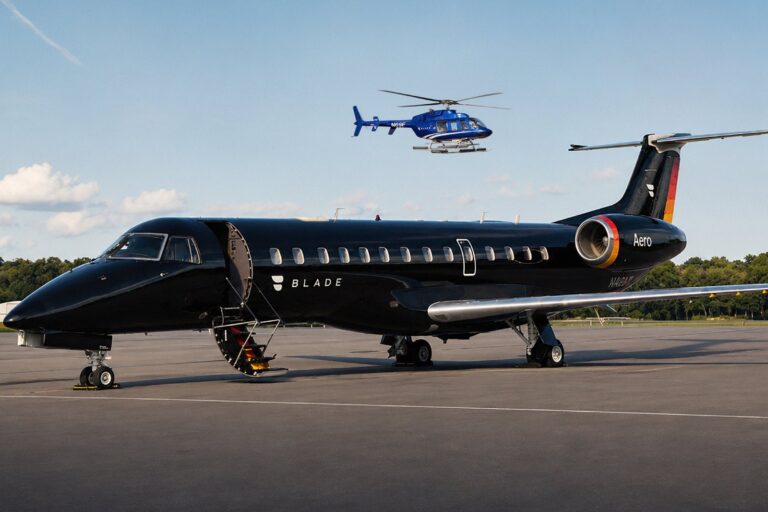
Blade, the urban air mobility company known for helicopter transfers in New York City, is relaunching its semiprivate jet service. The new offering, called BladeOne, will operate flights between Westchester County Airport (HPN) in New York and two South Florida destinations: Miami-Opa Locka Executive Airport (OPF) and President Donald J. Trump International Airport (DJT) in West Palm Beach, formerly known as Palm Beach International Airport (PBI).
The seasonal service launches on Thursday, November 19, 2026, and continues through May 2, 2027. Blade is partnering with Aero, a Los Angeles-based private jet operator, to manage flight operations under the Blade brand. This relaunch brings the semiprivate jet service back to market after a discontinuation in May 2024, when the original BladeOne service ended.
The Semiprivate Jet Market Expands
What semiprivate flying provides
Semiprivate jet services exist between commercial air travel and full private charter. These operators use smaller aircraft and dedicated private terminals, called fixed-base operators or FBOs, rather than the public terminals of major airlines. Passengers typically arrive 20 minutes before departure and board without the security lines and crowding of commercial airports.
The model has grown increasingly popular among business travelers willing to pay a premium to avoid traditional commercial hassles. Blade is re-entering this market with a direct competitor to JSX, which already serves the identical New York-to-South Florida routes.
JSX’s existing dominance
JSX has expanded significantly in recent years, operating customized regional jets on numerous city pairs. The airline uses private terminals to streamline boarding and reduce airport friction. CEO Rob Wiesenthal positioned BladeOne as occupying “the white space between a $1,000 first class seat and a $25,000 private jet charter,” indicating the company sees room for both services despite JSX’s established presence.
Aircraft Specifications and Cabin Comfort
JSX’s configuration approach
JSX operates the Embraer E135 and the larger E145, both configured to carry 30 passengers. The E135 features a 2-1 seat arrangement across 10 rows, while the E145 uses a 1-1 layout spanning 15 rows. JSX also operates ATR 72 turboprops on some routes, though not on the New York-South Florida service.
BladeOne’s all-premium cabin
Aero’s E135, which operates BladeOne flights, seats only 16 passengers in an all-premium 1-1 configuration across eight rows. This design cuts passenger capacity roughly in half compared to JSX’s aircraft, trading volume for what the company positions as enhanced comfort and exclusivity.
Onboard amenities are comparable between carriers. Both offer high-speed Starlink Wi-Fi, amenity kits, and food and beverages. The practical difference lies in seat density: BladeOne’s 1-1 configuration and lower passenger count per flight represents a materially different cabin experience than JSX’s more densely configured aircraft.
Manhattan Integration: Helicopter-to-Jet Connectivity
BladeOne introduces a feature that JSX does not emphasize: seamless bookings for helicopter transfers between Manhattan and Westchester County Airport. Passengers based in New York City, New Jersey, or Long Island can now book helicopter service from Manhattan directly into a BladeOne jet flight, eliminating the need for ground transportation to reach the airport.
This connectivity leverages Blade’s existing expertise in helicopter operations and uses its established infrastructure to reduce friction for travelers. For Manhattan-based passengers, the integrated booking option simplifies the departure process by consolidating two trips into one reservation.
Frequent Flyer Programs: A Decisive Gap
The loyalty program landscape reveals a critical difference between the two carriers. JSX partners with United Airlines and allows passengers to earn MileagePlus miles on every flight. This partnership benefits anyone working toward elite status, free upgrades, or redemptions within United’s extensive network.
Blade currently offers no frequent flyer program or airline partnership. The company does accept Bilt Cash, a newer rewards currency, for bookings, but this represents a narrower earning opportunity. For rewards-focused travelers flying the New York-South Florida route regularly, the absence of United partnership is a meaningful disadvantage. Frequent JSX passengers accumulate substantial mileage balances; BladeOne passengers cannot.
The Market Timing and Business Rationale
Blade cited two factors driving the relaunch: significant migration of New Yorkers to South Florida and increased business travel between the two regions. The New York-to-South Florida corridor ranks among the most traveled domestic routes, driven by real estate investment, business expansion, and lifestyle relocation.
The November 19 launch date provides approximately 1.5 months for operational finalization. The May 2, 2027 end date marks the service as seasonal, aligned with winter travel patterns when northern travelers typically migrate south and business activity between the two states peaks.
The dual South Florida destinations serve different markets. Miami-Opa Locka serves the broader Miami metropolitan area, while Trump International serves West Palm Beach and the northern Florida Gulf Coast. Westchester County Airport, the departure point, sits roughly 30 miles north of Manhattan.
BladeOne positions itself as a credible alternative to JSX. The smaller cabin size and Manhattan helicopter integration offer distinct value propositions, though the absence of frequent flyer partnership may prove decisive for certain travelers. The presence of two major semiprivate operators on identical routes suggests sustainable demand in the market.
Source: The Points Guy Articles
Frequently Asked Questions
When does BladeOne service begin and end?
BladeOne's seasonal service launches on Thursday, November 19, 2026, and continues through May 2, 2027.
What are the differences between BladeOne and JSX aircraft configurations?
BladeOne seats 16 passengers in 1-1 configurations across 8 rows, while JSX's E135 seats 30 passengers in 2-1 configurations across 10 rows. JSX's E145 also seats 30 passengers but uses 1-1 seating across 15 rows.
Can I earn frequent flyer miles on BladeOne flights?
BladeOne does not currently offer a frequent flyer program or airline partnership. JSX partners with United Airlines and allows passengers to earn MileagePlus miles on all flights.
