
Key takeaways
- SpaceX’s Starlink satellite network has fundamentally reshaped in-flight Wi-Fi performance, delivering streaming-quality connectivity that rivals ground-based broadband.
- Even as airline Wi-Fi speeds improve, carriers are increasingly restricting free access to frequent-flyer members, creating a two-tiered system where casual travelers pay while loyal customers connect for nothing.
- As airlines expand Wi-Fi availability, federal advisories warn that most in-flight networks remain dangerously vulnerable to cyberattacks.
- In-flight Wi-Fi transformed from a premium amenity available only to business-class passengers into a baseline expectation, yet performance and access patterns have diverged sharply.
While major U.S. carriers roll out complimentary in-flight Wi-Fi to loyalty program members, a stark performance gap reveals that most airlines still deliver speeds a fraction of what travelers experience at home. Hawaiian Airlines and Qatar Airways, powered by SpaceX’s Starlink low-Earth orbit satellites, achieved median download speeds of 152.37 Mbps in early 2025—while competitors like Air France and Lufthansa delivered just 4.14 Mbps on the same routes, exposing the vast gulf between next-generation and legacy satellite connectivity.
The Speed Revolution: Starlink Changes the Game
SpaceX’s Starlink satellite network has fundamentally reshaped in-flight Wi-Fi performance, delivering streaming-quality connectivity that rivals ground-based broadband. Hawaiian Airlines and Qatar Airways now rank as the industry’s fastest carriers, with upload speeds of 24.16 Mbps and latency of just 44 milliseconds—metrics that enable real-time video conferencing and lag-free streaming at cruising altitude. This performance advantage stems from Starlink’s dense constellation of low-Earth orbit satellites, which transmit data far closer to aircraft than traditional geostationary systems positioned 22,000 miles overhead.
The momentum is accelerating across the Atlantic and beyond. Air France began rolling out Starlink Wi-Fi in summer 2025 to Embraer 190s and A220s, with expansion to A350s and 777s underway; the carrier aims to cover 30 percent of its fleet by year-end 2025 and achieve full coverage by the end of 2026. British Airways signed its own Starlink deal in 2025, with installations beginning in Q3 2026 as part of a £7 billion passenger experience transformation plan that will ultimately deliver free high-speed Wi-Fi in every cabin.
The Loyalty Gatekeeping Model Becomes Standard
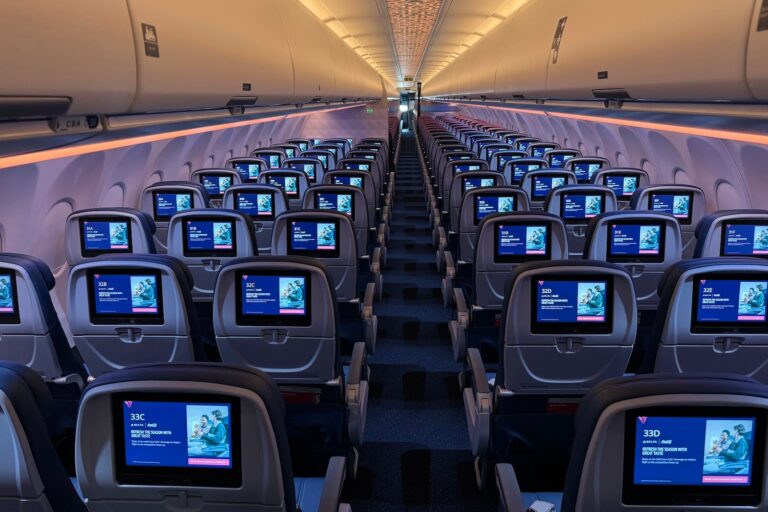
Even as airline Wi-Fi speeds improve, carriers are increasingly restricting free access to frequent-flyer members, creating a two-tiered system where casual travelers pay while loyal customers connect for nothing. Delta now offers fast, free Wi-Fi on more than 1,100 domestic aircraft exclusively to SkyMiles members, with full fleet coverage planned by the end of 2026; the carrier’s transatlantic routes to Europe, Israel, West Africa, Latin America, and South Africa gained access in fall 2025, and trans-Pacific routes launch in 2026. American Airlines follows suit, rolling out free high-speed Wi-Fi on 1,400-plus narrowbody and regional aircraft by early spring 2026 for AAdvantage members, while non-members pay at least $10—making American the airline with free Wi-Fi on the most planes globally.
Southwest and Delta partnered with T-Mobile to sponsor complimentary in-flight Wi-Fi for eligible passengers, though access requires free loyalty account registration. Only JetBlue stands apart, offering unlimited free Wi-Fi powered by Viasat to every passenger on every plane, regardless of cabin class or membership status—a competitive differentiator in an industry moving toward membership-based gatekeeping. Saudia launched its first fully internet-enabled flight on November 1, 2025, with free Wi-Fi up to 300 Mbps powered by Neo Space Group and SES satellite infrastructure; the carrier currently has 20 aircraft equipped and plans full fleet rollout.
Security Threats Shadow the Expansion
As airlines expand Wi-Fi availability, federal advisories warn that most in-flight networks remain dangerously vulnerable to cyberattacks. A July 2024 federal advisory highlighted that in-flight Wi-Fi networks are frequently unencrypted, exposing passengers to man-in-the-middle attacks, malware infections, and credit card interception. Travelers conducting sensitive financial transactions—booking hotels, entering banking credentials, or purchasing goods—face heightened risk on aircraft where network security lags far behind ground-based infrastructure standards.
Cybersecurity experts recommend using virtual private networks (VPNs), avoiding sensitive transactions, updating devices before boarding, enabling two-factor authentication on accounts, and disabling Bluetooth and AirDrop to mitigate exposure. These precautions become increasingly critical as more passengers rely on in-flight connectivity for work and personal business, yet airline Wi-Fi security protocols remain inconsistently implemented across the industry.
The Evolution of In-Flight Connectivity Over Five Years
In-flight Wi-Fi transformed from a premium amenity available only to business-class passengers into a baseline expectation, yet performance and access patterns have diverged sharply. The shift toward satellite-based systems—from geostationary networks like Viasat and Intelsat to low-Earth orbit constellations like Starlink—has created performance tiers that reward early adopters while leaving legacy-equipped carriers behind.
Among 30 airlines analyzed in 2025 performance rankings, Hawaiian Airlines and Qatar Airways dominated top positions, far surpassing competitors like British Airways, which achieved median download speeds of 22.57 Mbps. This disparity reflects not carrier investment alone but fundamental technology choices: LEO satellite networks deliver superior speed and latency compared to geostationary or ground-based LTE alternatives.
Key Milestones to Watch Through 2026
The in-flight Wi-Fi landscape will undergo dramatic transformation over the next 12 months as major carriers complete Starlink deployments and full-fleet rollouts accelerate. Delta targets complete domestic coverage by the end of 2026, while American Airlines aims to equip 1,400-plus aircraft by early spring 2026; Air France and British Airways both plan substantial Starlink expansion through 2026, with British Airways installations beginning in Q3 2026. Saudia’s full fleet rollout timeline remains under development, and additional carriers are likely to announce Starlink partnerships as the technology proves its performance advantages.
The competitive pressure is unmistakable: airlines that deploy Starlink gain measurable speed advantages that translate into passenger satisfaction, while carriers relying on legacy systems face performance comParisons that highlight their technological disadvantage. As these timelines unfold, travelers will increasingly experience not one standard of in-flight Wi-Fi but multiple tiers defined by satellite technology, membership status, and airline investment—making destination and carrier selection more consequential than ever for digital nomads and business travelers.
