

Key takeaways
- Discover's Q4 2026 categories—entertainment, restaurants and utilities—represent a shift from the holiday shopping focus that historically dominated the quarter.
- New cardholders earn cash back matches and statement credits in addition to the 5% rate, potentially doubling first-year earnings from bonus categories.
- The $1,500 quarterly cap applies across all three categories combined, allowing cardholders flexibility in how they allocate spending.
- Activation is not retroactive, so cardholders must register before making eligible purchases to earn the 5% rate.
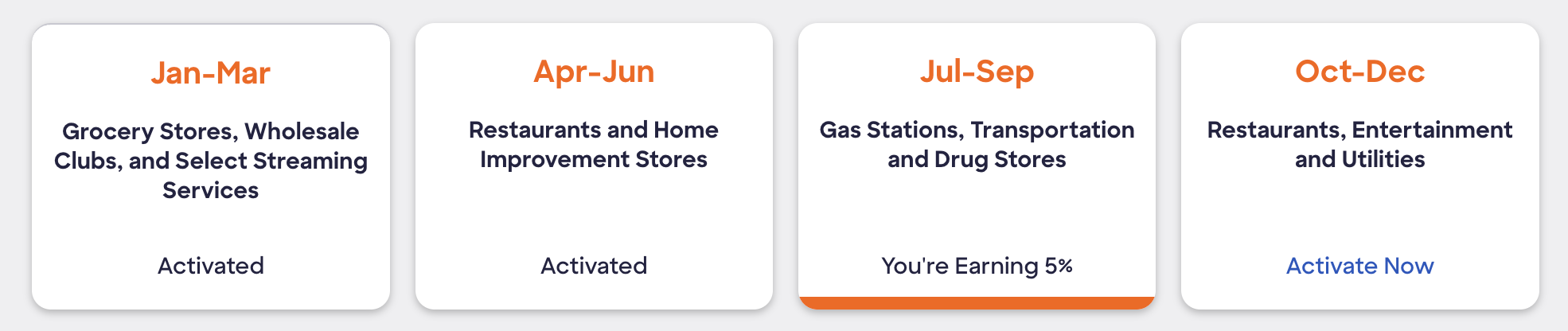
Discover has announced the fourth-quarter bonus categories for its rotating cash-back cards, setting entertainment, restaurants and utilities as the focus for the final three months of 2026. Starting October 1, cardholders on the Discover it® Cash Back and Discover it® Student Cash Back can activate to earn 5% cash back on up to $1,500 in combined eligible purchases across all three categories.
The Q4 2026 Categories: A Departure From Tradition
This year’s lineup represents a notable shift in Discover’s quarterly strategy. From 2017 through 2025, Amazon appeared in the fourth-quarter rotation every single year, often joined by Target or Walmart to capitalize on holiday shopping patterns. For 2026, none of these major retailers made the cut.
The move signals a recalibration toward categories tied to experiences and consistent household spending rather than a seasonal shopping push. Entertainment and restaurants cater to year-end gatherings and celebrations, while utilities address expenses that remain steady regardless of season.
Entertainment and Dining as Experience Categories
The inclusion of entertainment and restaurants groups together discretionary spending associated with holidays and travel. These categories capture end-of-year events, holiday parties, concert tickets and restaurant reservations—the kinds of expenses many people concentrate in the final quarter.
Utilities as a Recurring Expense Play
Utilities represent an uncommon appearance in Discover’s quarterly rotations. This addition encourages cardholders to use the card for bills—electricity, gas, water—that typically cycle through automatically. One consideration: some utility providers charge a fee for credit card payments, so cardholders should verify whether the 5% cash back justifies the potential surcharge.
Earning Strategy and the $1,500 Cap
Discover’s cash-back structure pairs a high earn rate with a quarterly spending ceiling. Cardholders who activate and spend the full $1,500 across all three bonus categories during Q4 will earn $75 in cash back at the 5% rate. That figure multiplies to $300 annually if the cap is maxed every quarter.
The spending limit applies to the combined total across all three categories, not to each category individually. A cardholder might allocate $500 to restaurants, $600 to entertainment and $400 to utilities—or any other split—and still reach the $1,500 threshold that caps out the 5% earnings.
Once the quarterly cap is reached, additional purchases in the bonus categories revert to the card’s standard 1% cash-back rate. This structure rewards planned spending but doesn’t penalize cardholders for exceeding the limit.
Comparing Discover to Other Cards in Your Wallet
A 5% cash-back rate on restaurants and entertainment is competitive but not always optimal. Some travel cards earn 3x points on dining, which can deliver higher redemption value depending on the program’s point valuation. Cardholders should compare the Discover rate to any premium cards they carry before automatically choosing Discover for every eligible purchase in these categories.
Activation: Timing and Process
Activation is now open and will remain available through at least October 1, when the new categories take effect. Cardholders who activate before October 1 will be ready to earn from day one. Those who activate after the quarter begins will still earn 5% cash back, but only on purchases made after their activation date—Discover’s cash-back rates are not retroactive.
Activation occurs through either the Discover mobile app or the online account portal. In the app, cardholders select their card, navigate to the rewards or cash-back section and tap “Activate Now.” On desktop, logging into the Discover account and selecting “Activate Now” next to the Q4 bonus categories achieves the same result.
For accounts that have migrated to Capital One, the activation process remains identical, accessible through either the Capital One app or online account. The earning rate and mechanics do not change.
Why Early Activation Matters
Waiting until mid-October to activate means forfeiting the 5% rate on any eligible spending made earlier that month. A restaurant reservation booked for October 5 would earn only 1% cash back if activated on October 15. The safest approach is to activate immediately upon learning the categories, ensuring no eligible purchases slip through at the lower rate.
Maximizing Rewards in Your First Year
New cardholders receive two separate first-year bonuses. Discover automatically matches all cash back earned during the first year—not just from the rotating categories, but from all purchases—with no minimum or maximum match amount. A new cardholder who earns the maximum $75 from Q4’s 5% categories would receive a $75 match at year-end, doubling those earnings to $150.
This match applies across every quarterly bonus period during the first twelve months, so a new cardholder who maximizes all four quarters would accumulate $300 from the 5% categories plus another $300 from Discover’s automatic match, totaling $600 before any 1% baseline earnings.
Discover it Student Cash Back applicants have an additional promotion running through late September: new cardholders can earn a $100 statement credit after spending $300 in purchases during their first three months. This bonus stacks with the Cashback Match benefit.
The Broader Q4 Context
The October-to-December focus on restaurants, entertainment and utilities contrasts with Q3, which concludes September 30. Through the end of this month, cardholders can still activate and earn 5% cash back on gas stations and EV charging, airlines and public transportation, and drugstores—a lineup spanning fuel, transit and pharmacy purchases.
Cardholders who haven’t yet maximized Q3 spending should activate those categories before September 30 if they haven’t already. The opportunity to earn 5% on airline tickets and EV charging, in particular, carries value for travel-focused consumers and electric vehicle owners.
Calendar Planning for Maximum Rewards
Strategically timing card usage across quarters requires mapping personal spending patterns against the announced categories. Q4 2026 rewards experiences and bills; anticipating which of these expenses fall within your typical spending can determine how much of the $1,500 cap you’ll actually use.
Redemption and Mechanics
Cash back earned during a billing cycle is added to the rewards balance after the monthly statement closes. Once available, it can be redeemed at any time with no minimum redemption amount. Options include a statement credit, direct deposit to a bank account or other redemption pathways Discover offers.
This flexibility contrasts with travel credit card points, which often restrict redemption to travel or force valuations at specific partner rates. Discover’s cash back is liquid and fully user-directed.
Frequently Asked Questions
When does Discover's Q4 2026 cash-back bonus start?
The bonus categories go live October 1, 2026, and run through December 31. Activation is available now through the Discover app or online account.
What's the maximum cash back I can earn from the Q4 categories?
If you spend the full $1,500 combined across entertainment, restaurants and utilities, you'll earn $75 in cash back at the 5% rate.
Is there a bonus for new cardholders?
Yes. New cardholders receive Discover's Cashback Match, which automatically doubles all cash back earned during the first year with no limit. Discover it Student Cash Back also offers a $100 statement credit after spending $300 in the first three months.
